welcome to mies and peas!
your nonstop source of everything science of architecture, including information for the ARE, LEED, and PE exams.
Showing posts with label client relations. Show all posts
Sunday, September 11, 2011
MIES - Nest
What if you brought the world into your home with you? This small home, located at the foot of a mountain near Onomichi City, Japan, was built by UID architects for a family of four. In the family, there were three females (one mother and two daughters) and an early concept of the house included a sense of nesting, which echoed their sentiments as to the home they would like to live in. The eventual design expanded this idea a little, transforming the nest into a forest within. A from that, standard Japanese philosophies of transcendence, from forest to earth to universe, overrode, giving this final home a sense of scale.
The entrance to the home is one the ground floor. Visitors pass through a planted garden (shown above) the grows up to the full height of the house. This is in standard line with Japanese mythology, where trees such as peach blossoms represent powerful universal ideals.
The whole building feels like a single space. As a structure, it comprehends surroundings and environment by rethinking elements such as floors and walls. In the ground layer, some spaces are connected to each other by a tunnel that becomes concrete, which gives a sense of foundation.
Above the ground, a floating wooden nest box composed of branches and fallen leaves cover the nest on the ground surface. Although the composition floors, voids and walls make the architectural elements seem separated, they instead become vital links of architecture to the outer context, and help one from inside view the world beyond.
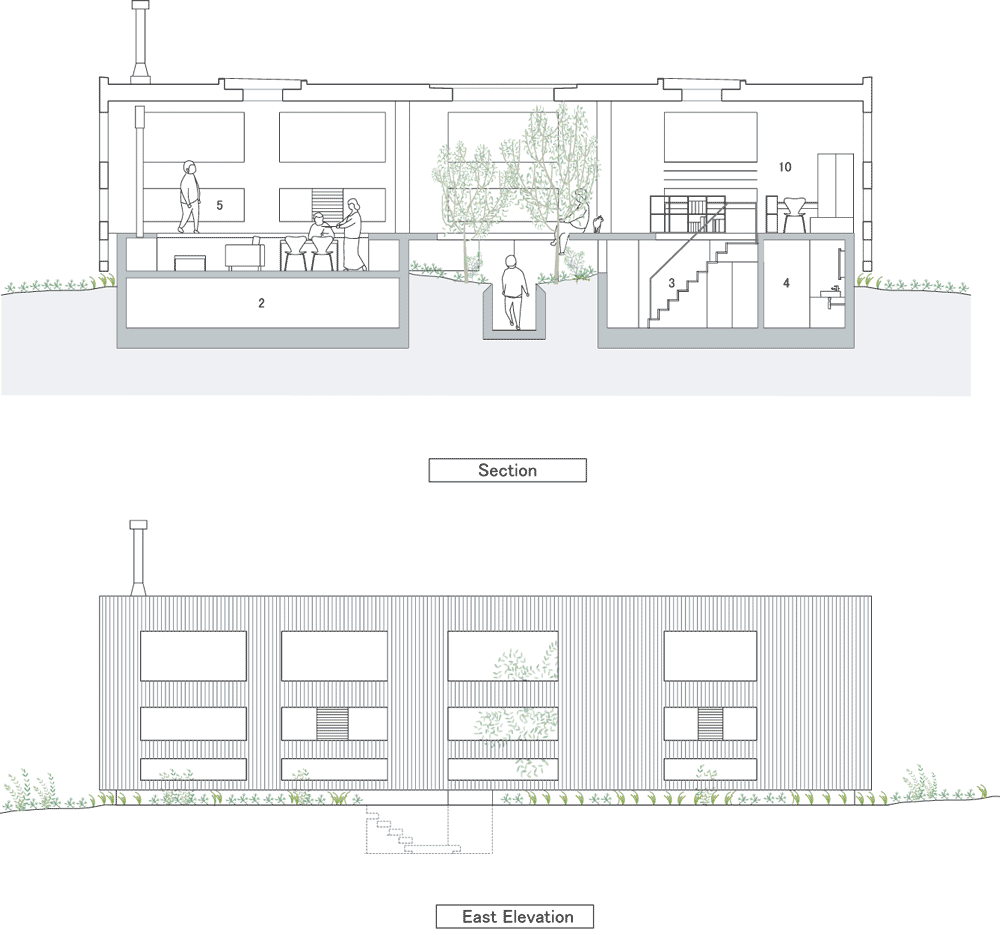
And from the plans and elevations, we see this continue. The apertures are placed evenly near the living quarters of the home and increase in height (rather than decrease) as the elevation rises. This stays true to the sense of universal scale, and falls away from conventional architectural thinking. It is emblematic of the best in natural Japanese philosophy and as such, somewhat transcends its own architecture entirely.
Labels:
client relations,
concrete,
foundations,
Japan,
mythology,
nesting,
Onomichi City,
scale,
UID architects,
wood
Saturday, May 2, 2009
PPP Notes - Project Management

(These notes are compiled from AHPP)
PROJECT TEAMS
- THE PROJECT MANAGER
- The central figure on a project team is the project manager (PM).
- This is the person in the firm who is responsible for managing a team of diverse people and interests.
- Must balance design, schedule, a budget concerns to meet client expectations.
- HISTORIC RESPONSIBILITIES:
- Client expectations:
- First responsibility of the project manager is to identify client expectations.
- Communication skills are important
- Accomplishment:
- Next important responsibility of the project manager is to get things done.
- Taking charge:
- A project team requires sensitive guidance and direction.
- Must allow judgment and creativity within constraints of project.
- Service:
- The ability to manage client relationships successfully is an important skill.
- “Serve without being servile.”
- Willingness to tell the client something he/she does not want to hear.
- Meeting contractual obligations:
- Meet a firm’s obligations as outlined in the agreement for professional services with the client.
- INNOVATIVE ROLES:
- Marketing:
- The best way to secure additional work is to do good work.
- The more successful firms expect PMs to assume an active role in securing more new business.
- Thus, the PM leads the proposal effort.
- Financial:
- The PM needs to lead the effort to secure payment from the client.
- All projects start with a defined budget or at least an expectation of cost.
- It is up to the PM to define the client’s budget and establish a financial baseline before the project begins.
- Profit must be included in the budget.
- Securing payment from the client has traditionally been considered to be the responsibility of the accounting department, but in the more successful firms PMs tend to lead this effort.
- PMs can also expedite review of invoices prepared by the firm’s accounting department to speed their issue to the client.
- PLACE IN THE FIRM:
- In smaller firms, the principals and PMs are synonymous.
- In larger firms, principals typically manage projects. When he is too busy, or when the firm delegates day-to-day project management to someone who is not a principal, it is common to have a principal-in-charge.
- Where there is a principal-in-charge and a PM, the two need to build a strong relationship. Any delegation of management responsibility should be clear, consistent, and devoid of second-guessing.
- TRAITS AND ABILITIES:
- Effective PMs are characterized by their ability to organize a design project and to deliver high-quality, on-time, and within-budget performance.
- Traits of a PM are:
- They are organized
- They are enthusiastic about achieving high standards
- They communicate well
- They provide motivation
- They delegate when appropriate
- They listen well and can interpret clearly team members’ issues and opinions.
- They attack every problem important to success.
- They are persuasive in a pleasing and nonbelligerent manner.
- They are conscious of time, know what it takes to accomplish a task, and is aware of time limitations.
- They know where to find the answers for technical and managerial problems.
- They appreciate the hard work of the team and they give credit to the group.
- They are result-oriented and keep the final outcome of the project in mind.
- MANAGING STAFF AND CONSULTANTS
- In addition to the PM, most architect projects involve at least one other person. This can include a part-time draftsperson, a consultant, the contractor, and, of course, the client.
- SELECTING IN-HOUSE STAFF:
- The architecture firm’s staff forms the core of the project team.
- In-house staffing involves establishing the specific skills and the level of effort (measured in hours) needed to perform the services, identifying the people to work on the project, and balancing the needs of the project with those of the firm and its other projects.
- It’s natural for people in-house to compete for projects within the firm. PMs need to recognize that the firm’s leaders must make personnel assignments that are best for the entire office, not just for one of its projects.
- DELEGATING TO OTHERS:
- One of the most difficult tasks for project managers is to delegate responsibility properly.
- Delegation spread the workload, encourages initiative, and helps train additional staff.
- For each task, it is wise to:
- 1. Identify the team member most capable of doing it
- 2. Give that person the responsibility and authority he or she needs to complete the task
- 3. Establish the level of performance required
- 4. Define the completed activity or results
- 5. Agree on the level of effort and time required
- 6. Establish a suitable completion date
- 7. Establish interim milestones or other approaches for checking progress
- The level of checking is a function of the importance of the task and the confidence a PM has in the person doing the work.
- The PM can identify a level in confidence by checking on the team member doing the work – via “management by walking around.”
- [A personal aside – PMs are the laziest sons of bitches in this world and are a net result of the bottom falling upwards]
- Task Assignments:
- Assigning work to in-house staff colleagues affords the PM an opportunity to plan at a more detail level.
- The PM may want to write down assignments or ask staff and consultants to take notes and furnish copies. This helps maintain documentation of delegated work.
- Consultants and Other Design Team Members:
- The PM is responsible for the performance of the project consultants.
- Commitment can be heightened by involving consultants and other design team members in project planning and by applying many of the same ideas about motivation and recognition used with in-house staff.
- MANAGING THE CLIENT
- A PM’s ability to work with clients will determine the firm’s ability to meet objectives.
- The first step in working successfully with clients is to learn as much as you can about them and their organization.
- ASK:
- Who influences project decisions?
- Who is responsible for scope, quality, schedule, and budget?
- Who has the authority to modify the contract?
- Who will approve the firm’s services and evaluate the firm’s performance?
- CLIENT PERSONALITIES:
- Clients have personality types, work styles, behavioral traits. Their needs, priorities, and operating style may be quite different. A PM must adapt to this.
- Client may be a reader or a listener. Find out which.
- CLIENT RELATIONSHIPS:
- Relationships between architects and clients can take many forms.
- At one end of the spectrum, the architect has a good deal of autonomy and is highly influential. At the other extreme, are relationships when the firm is hired to do highly specific jobs within rigid constraints.
- Clients differ on the level of involvement they seek in their projects.
- CLIENT DECISIONS:
- The effective PM realizes that the client has engaged the firm to employ its professional skill and judgment; thus the PM is not a “yes” man.
- A wise PM proposes and discusses possibilities.
- The most damaging thing a PM can do is to lead a client into believing a project is in better shape than it actually is.
- When it becomes apparent that meeting the schedule or budget is becoming a problem, an effective manager informs the client as soon as possible.
- AGENCY COORDINATION:
- The PM assists the owner in coordinating with government agencies and regulatory bodies.
- Building departments, environmental regulators, and others can cause schedule delays and budget overruns even if reviews and approvals are well prepared.
- EFFECTIVE TEAMS
- Self-motivation tends to be an inherent characteristic of people in architecture firms and other professional organizations.
- INDIVIDUALS AND PERSONALITIES:
- We know a great deal more about individual effectiveness.
- Often this begins with understanding the individuals involved in the project – the project manager, principal-in-charge (if there is one), key team members, and the client’s representatives – and how they gather information, make decisions from it and disseminate it accordingly.
- TEAM BUILDING
- An effective team is more than the sum of its individuals.
- One of the PM’s challenges is to build the team, or still better, to help the team build itself into an effective working group.
- Effective teams are:
- Small enough to convene and communicate easily.
- Capable of fostering interactive discussions.
- Mutually understanding of each other’s roles.
- An appropriate combination of functional/technical, problem-solving, and interpersonal skill.
- Those that have a truly meaningful, well-understood purpose.
- Composed of both team and individual goals.
- Those that plan for a specific set of team work products.
- Those that have a sense of mutual accountability.
- Willing to measure progress against specific goals.
- Teams that believe that only the “team can fail.”
- Effective teams have a working approach that:
- Is understood and agreed to by everybody.
- Capitalizes on (and enhances) the skills of those on the team.
- Provides for open interaction, fact-based problem solving, and results-based evaluation.
- Can be modified and improved over time.
Labels:
client relations,
consultants,
delegating,
managing,
project manager,
staff,
teams
Subscribe to:
Posts (Atom)


